

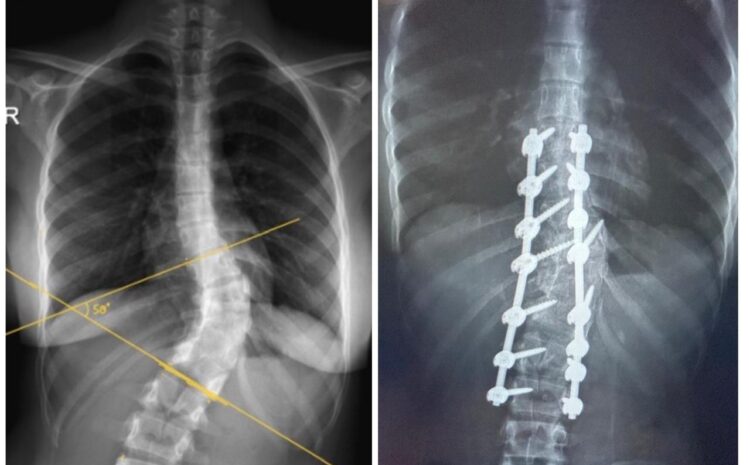
Congenital Scoliosis Correction with Hemivertebra Excision
Congenital scoliosis is a rare spinal condition that develops due to abnormal vertebral formation before birth. If left untreated, the spinal curve can worsen as a child grows, leading to significant deformity, posture imbalance, and reduced quality of life. In this case, a 14-year-old girl presented with a severe and rigid congenital spinal curve caused by a hemivertebra and a bony bar. Through advanced spinal deformity surgery, successful correction was achieved using hemivertebra excision, bony bar removal, and multilevel facetectomy.
Understanding the Condition
A hemivertebra is a wedge-shaped vertebra that develops when only one side of the spinal bone forms properly. As a result, the spine grows unevenly and gradually develops a curve. In addition, the presence of a bony bar can restrict spinal growth on one side, making the deformity more rigid and progressive.
Consequently, patients may experience:
- Visible spinal curvature
- Uneven shoulders or hips
- Poor posture
- Trunk imbalance
- Back discomfort
- Progressive spinal deformity
Therefore, early evaluation by a spine specialist is essential to prevent further progression.
Patient Case Overview
A 14-year-old girl was diagnosed with a stiff congenital scoliosis curve caused by a hemivertebra and an associated bony bar. The deformity had become rigid over time, limiting spinal flexibility and affecting overall alignment.
After a detailed clinical examination and advanced imaging studies, a customized surgical plan was developed to correct the deformity and restore spinal balance.
Surgical Procedure Performed
The patient underwent a complex spinal deformity correction procedure involving multiple advanced surgical techniques.
Hemivertebra Excision
The abnormal hemivertebra was completely removed. Since the hemivertebra was the primary cause of the spinal curve, its excision allowed direct correction of the deformity at the source.
Bony Bar Removal
The bony bar restricting spinal growth was carefully removed. This step improved spinal mobility and created better conditions for curve correction.
Multilevel Facetectomy
Facetectomy was performed at multiple spinal levels to release stiff segments of the spine. Furthermore, this technique increased spinal flexibility and helped achieve a more balanced correction.
Spinal Alignment and Stabilization
After correcting the deformity, spinal instrumentation and fixation were used to maintain proper alignment and provide long-term stability during the healing process.
Benefits of Surgical Correction
Advanced congenital scoliosis surgery offers several important benefits, including:
- Improved spinal alignment
- Better posture and balance
- Prevention of further curve progression
- Enhanced cosmetic appearance
- Increased spinal stability
- Improved long-term functional outcomes
Moreover, modern spinal deformity correction techniques allow surgeons to achieve precise correction while preserving spinal integrity.
Recovery and Follow-Up
Following surgery, the patient was closely monitored through regular follow-up visits and imaging evaluations. Rehabilitation and guided physical activity played an important role in recovery.
Additionally, ongoing follow-up ensured that spinal alignment remained stable and that healing progressed as expected.
Why Early Treatment Is Important
Congenital scoliosis often progresses during growth spurts. Therefore, timely diagnosis and treatment are critical. Early intervention can prevent severe deformity, improve spinal function, and reduce the need for more extensive surgery in the future.
Furthermore, advanced surgical techniques now provide excellent outcomes for patients with complex congenital spinal deformities.
Conclusion
This case highlights the successful correction of a stiff congenital scoliosis curve in a 14-year-old girl using hemivertebra excision, bony bar removal, and multilevel facetectomy. Through careful planning and advanced spine surgery techniques, significant spinal correction and improved alignment were achieved. As a result, the patient gained better posture, spinal balance, and a healthier future.